

Executive Summary
Over an eight-week window spanning the 2026 Raksha Bandhan season (July 1 – August 27), Rakhi By Diorin deployed WeUpsell AI across three distinct touchpoints in its online store: product pages, the cart drawer, and a recommendation popup. What makes this case study useful isn't just the headline number — it's that the three placements behaved completely differently from one another. One placement won on reach, one won on conversion rate, and one won on efficiency relative to its size.
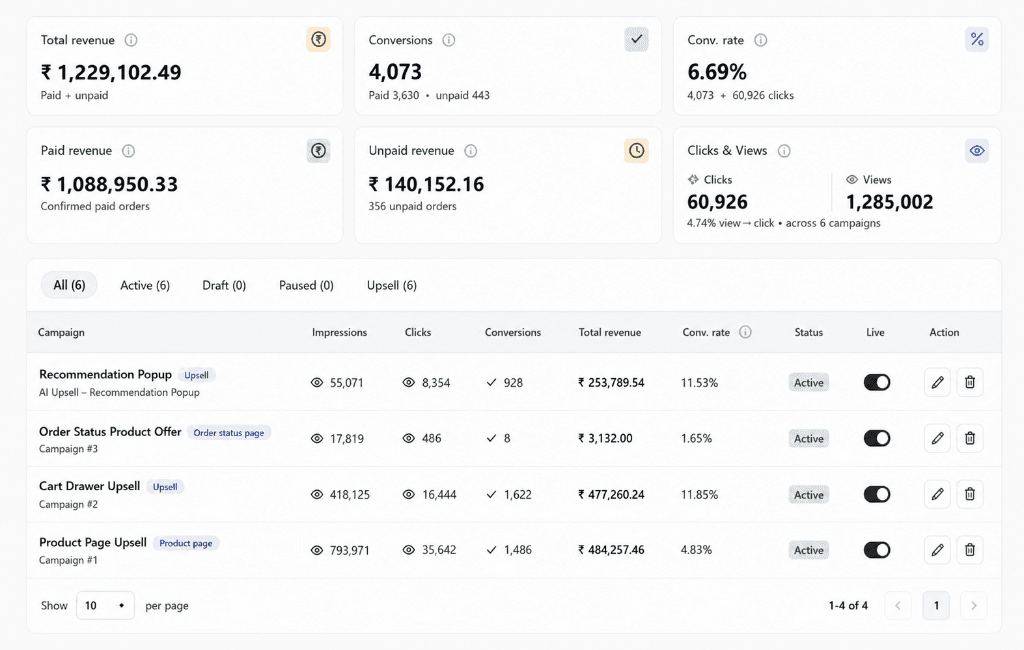
WeUpsell Dashboard — Rakhi By Diorin account overview showing all 6 active campaigns and ₹12,29,102.49 in total attributed revenue
The Context: A Short Window, A Wide Catalogue
Raksha Bandhan is a compressed shopping window. Customers arrive with a specific, immediate need — a rakhi for a brother, a set for a bhai-bhabhi pair — and once that need is met, they typically check out and leave. The problem for a brand like Rakhi By Diorin isn't a lack of relevant products. It's that most shoppers never see them.
A customer buying one rakhi is very often also a candidate for:
- A second rakhi for another sibling or cousin
- A matching Bhai-Bhabhi ceremonial set
- A festive gift hamper or combo box
- Traditional mithai, dry fruits, or puja accessories for the occasion
With a catalogue spanning hundreds of possible combinations, manually building bundles for every scenario isn't practical — especially in a fast-moving festive season. The brand needed a way to answer one question at scale: if a shopper is looking at this product, what should they see next?
There's also a timing dimension that makes this harder than a typical e-commerce upsell problem. Raksha Bandhan isn't a slow-building sales period — it arrives, peaks, and closes within a matter of weeks. Any recommendation system deployed for the season has to work correctly from day one; there's no long tail in which to gradually tune it. By the time a merchandising team has hand-picked and tested pairings across a catalogue this size, a meaningful part of the selling window has already passed.
About Rakhi By Diorin
Rakhi By Diorin is a handcrafted rakhi and festive gifting brand based in Kolkata, with a catalogue built specifically around Raksha Bandhan and family celebrations.
- Brother and Sister Rakhis
- Bhai-Bhabhi Sets
- 925 Pure Silver Rakhis
- Kids' & Cartoon Rakhis
- Bracelet-style & Semi-Precious Stone Rakhis
- Rakhi Combos and Festive Gifting Sets
- Mithai, Dry Fruits, and Ceremonial Roli-Chawal Accessories
How the AI Recommendation Layer Works
Rather than relying on a merchandiser manually deciding 'customers who buy X should see Y,' WeUpsell AI builds product-to-product relevance by analyzing signals across the store — including browsing patterns, co-purchase behavior, and product attributes (category, price band, occasion tags, and materials).
For a catalogue like Rakhi By Diorin's, this matters because relevance isn't always obvious from category alone. A shopper looking at a Bhai-Bhabhi set might be a strong candidate for a kids' rakhi (if they're shopping for a whole family) or for mithai (if they're building a gift box) — but a rigid 'customers who bought this also bought that' rule can miss those connections, especially early in a season before enough purchase history has accumulated.
The system continuously adjusts which products it surfaces as real-time interaction data flows in throughout the festive surge, rather than relying on a static set of bundles decided once at the start.
The Approach: Three Placements, Three Jobs
Instead of relying on manually curated bundles, Rakhi By Diorin used WeUpsell AI to surface relevant product recommendations at three key moments in the shopper's journey:
| Placement | Where it appears | What it does |
|---|---|---|
| Product Page Upsell | While the shopper is browsing | Surfaces relevant products before a primary decision is made |
| Cart Drawer Upsell | After a product is added to cart | Suggests a complementary add-on at the point of highest intent |
| Recommendation Popup | A separate discovery trigger | Creates an additional high-intent chance to surface relevant products |
The Results by Placement
Product Page Upsell: The Scale Engine
₹4.84L RevenueThe Product Page was the single largest revenue contributor, driven primarily by reach (793,971 impressions and ₹4,84,257.46 in revenue). Its conversion rate wasn't the highest of the three placements, but exposure to hundreds of thousands of shoppers was enough to make it the top revenue driver in absolute terms. The lesson: the highest conversion rate doesn't always produce the most revenue — volume matters too.
Why did the Product Page convert lower than the other two placements? A shopper on a product page hasn't committed to anything yet — they're often still comparing options, deciding on a budget, or figuring out who they're buying for. A recommendation shown here is competing with the primary decision the shopper is still making. That's a fundamentally different job than the Cart Drawer: building awareness of options the shopper might return to later in the session, or add alongside the item they eventually choose.
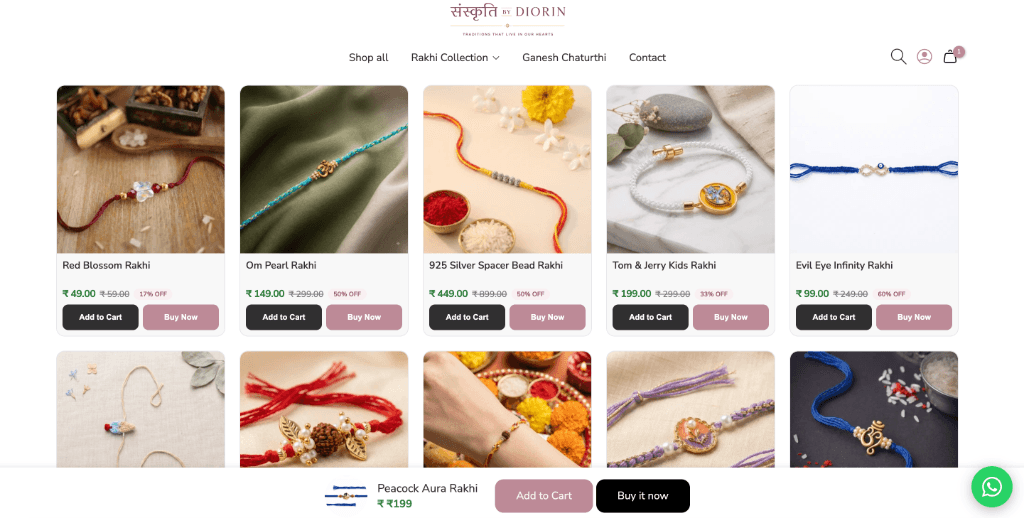
Product Page AI Recommendations — "You may also like" section displaying personalized complementary rakhis below the main product details.
Cart Drawer Upsell: The Intent Engine
11.85% Conv. RateOnce a shopper had already committed to buying something, recommendations performed markedly better: 1,622 conversions, ₹4,77,260.24 in revenue, and an 11.85% conversion rate — more than double the Product Page's rate.
At this stage, the recommendation isn't trying to convince someone to buy from the store — they've already decided to. It only has to answer one question: 'Would you like to add this too?' That shift in intent is reflected directly in the conversion rate. The fact that the Cart Drawer converted at nearly 12% confirms the recommendations landed as genuinely relevant additions (a second rakhi, a combo, or a sweet box) rather than generic cross-sells.
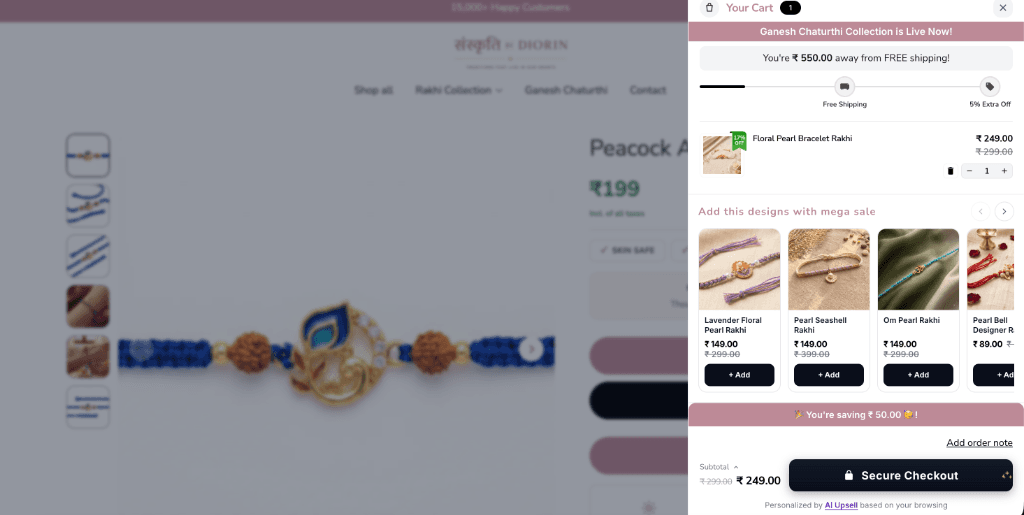
Cart Drawer Upsell — Slide-out cart drawer with "Add this designs with mega sale" one-click add-ons. Converted at 11.85%.
Recommendation Popup: The High-Efficiency Placement
20.6% Revenue ShareThe popup had by far the smallest reach of the three placements, but converted disproportionately well: 55,071 impressions, 928 conversions, ₹2,53,789.54 in revenue, and an 11.53% conversion rate.
Despite reaching a fraction of the audience the Product Page did, the popup accounted for roughly 20.6% of total WeUpsell-attributed revenue. The trigger conditions were tuned closely so that the popup appeared to shoppers already primed to act, rather than interrupting them indiscriminately. That precision is the difference between a popup that lifts revenue and one that increases bounce rate.
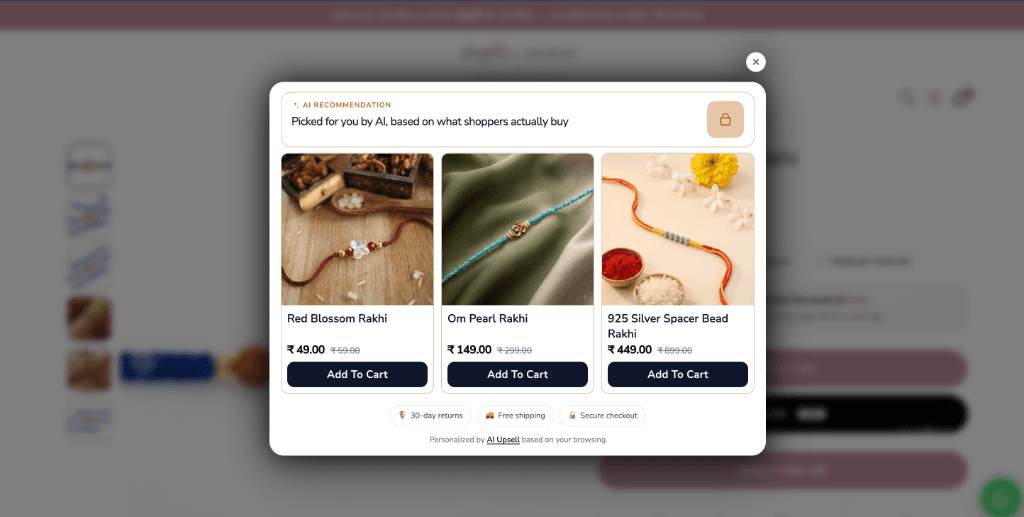
Recommendation Popup Modal — High-intent trigger showing "Picked for you by AI, based on what shoppers actually buy" with 11.53% conversion rate.
Performance Summary
| Placement | Impressions | Conversions | Conv. Rate | Revenue |
|---|---|---|---|---|
| Product Page Upsell | 793,971 | 1,486 | 4.83% | ₹4,84,257.46 |
| Cart Drawer Upsell | 418,125 | 1,622 | 11.85% | ₹4,77,260.24 |
| Recommendation Popup | 55,071 | 928 | 11.53% | ₹2,53,789.54 |
Account-Level Results (Jul 1 – Aug 27, 2026)
| Metric | Result |
|---|---|
| Total WeUpsell Revenue | ₹12,29,102.49 |
| Paid Revenue | ₹10,88,950.33 |
| Unpaid Revenue | ₹1,40,152.16 |
| Total Conversions | 4,073 |
| Paid Conversions | 3,630 |
| Unpaid Conversions | 443 |
| Overall Conversion Rate | 6.69% |
| Clicks | 60,926 |
| Widget Views | 12,85,002 |
| Revenue Per Conversion | ₹301.77 |
Figures reflect WeUpsell dashboard data for Jul 1 – Aug 27, 2026, as reported by the merchant. The three placements detailed account for the vast majority of total attributed revenue and conversions.
What This Reveals for Festive and Gifting Brands
1. Existing traffic has massive untapped revenue potential
The Product Page alone reached nearly 794,000 impressions. Rather than treating each visitor as a single-product transaction, relevant recommendations turned that same traffic into additional revenue opportunities.
2. Shopper intent fundamentally changes conversion performance
The Cart Drawer converted at 11.85% versus 4.83% on the Product Page — a meaningful gap that reflects where the shopper is in their decision, not just what is being recommended.
3. Reach and impact aren't the same thing
The Recommendation Popup reached a fraction of the audience the Product Page did but still generated ₹2.53 lakh in revenue — proof that smaller, well-targeted placements can meaningfully move the needle.
4. Festive shopping is naturally suited to discovery
Raksha Bandhan customers are shopping for people and relationships, not a single isolated item. That context makes relevant, well-timed recommendations feel like natural customer service rather than a pushy upsell.
Frequently Asked Questions
Is this incremental revenue, or would some of these customers have bought anyway?
The figures above are WeUpsell-attributed revenue — meaning they reflect purchases where a WeUpsell recommendation was clicked as part of the path to conversion. This is standard attribution methodology for recommendation and upsell tools. Merchants who want to isolate true incremental lift can also run holdout tests alongside attribution data.
Does this only work for large catalogues?
No — the underlying principle (matching a shopper's current product to a relevant next one) applies to smaller catalogues too, though the specific value of AI-driven matching over manual bundling increases as catalogue size and combination complexity grow.
Why did the Cart Drawer outperform the Product Page on conversion rate?
Primarily because of where the shopper is in their decision-making process. By the time someone reaches the cart, they've already decided to buy — the recommendation only needs to add to an existing purchase decision rather than create one from scratch.
Would this work outside of a festive season?
Festive periods like Raksha Bandhan tend to produce stronger results because shopper intent to buy multiple, related items is naturally higher. The same placements can run year-round, though conversion rates during non-festive periods are likely to be more moderate.
The Takeaway
Rakhi By Diorin didn't need more shoppers to grow revenue during Raksha Bandhan 2026 — it needed to make the next relevant product easier to find for the shoppers it already had. By layering AI-powered recommendations across the product page, cart drawer, and popup experience, the brand generated ₹12,29,102.49 in total attributed revenue from traffic it was already receiving.
Want Results Like This for Your Store?
If your catalogue has products that naturally belong together — whether that's festive gifting, apparel, beauty, or accessories — the same three-placement approach used here can be set up on your store without building or maintaining manual bundles by hand.