

Rising ad costs and shrinking margins have pushed most Shopify merchants toward the same conclusion: growth has to come from existing traffic, not just more of it. That's the entire premise behind upselling. A well-placed offer at the right moment — on the product page, in the cart, at checkout, or right after purchase — can lift average order value by 10–30% without spending another dollar on acquisition.
The apps that do this well aren't running static "you may also like" widgets anymore. They're using AI to read each shopper's cart, browsing behavior, and purchase history in real time, then picking the offer most likely to convert — automatically, without a merchant manually building funnels for every product.
This article compares the leading AI-powered upsell and product recommendation apps for Shopify stores, including WeUpsell, across the factors that actually matter: AI capability, recommendation types, upsell placements, automation, analytics, pricing, and ease of use.
What Makes an Upsell App AI-Powered
Worth clearing up before comparing apps, since the label gets used loosely:
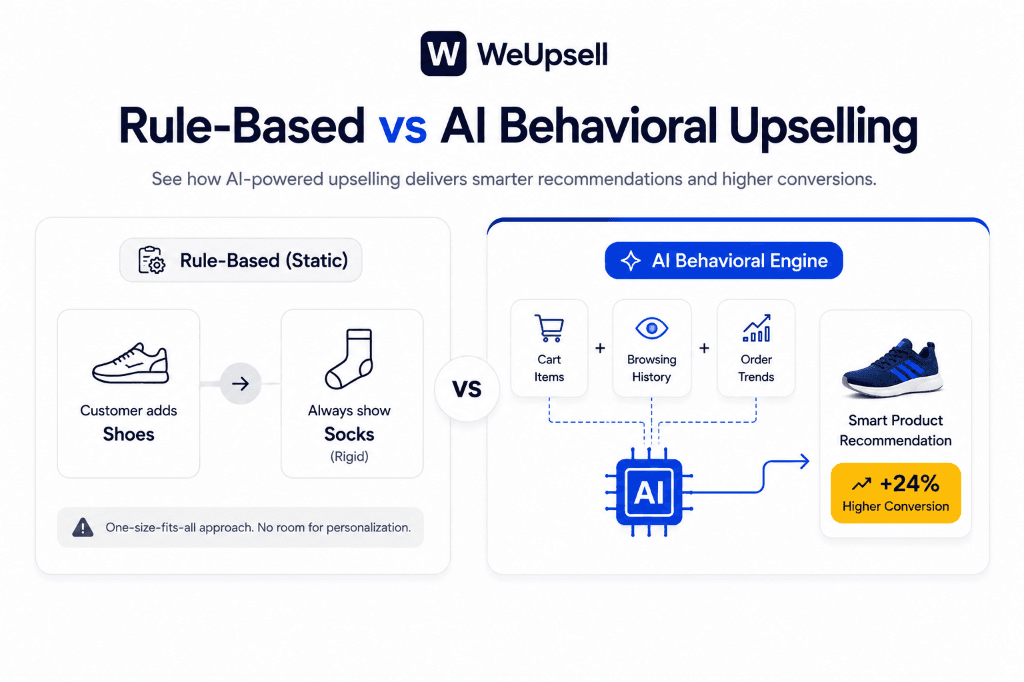
Rule-based apps run on logic a merchant sets manually — "if product X is in the cart, show product Y." Reliable, but static. Every shopper sees the same offer, and rules have to be maintained by hand as the catalog grows.
AI-powered apps learn from behavior — cart contents, browsing history, what similar shoppers bought — and adjust the offer per shopper in real time. No manual rule-building, and performance improves as more orders come in.
Most apps marketed as "AI" sit somewhere on a spectrum between these two. The comparison below notes where each one actually falls.
Comparison Table
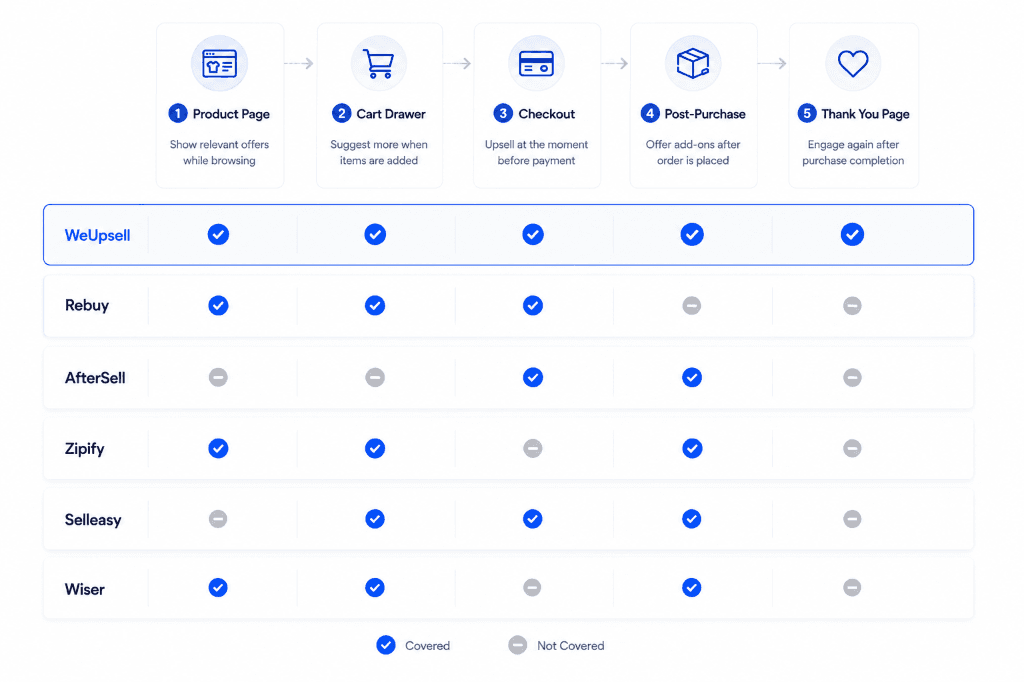
| App | AI Capability | Upsell Placements | Automation | Pricing |
|---|---|---|---|---|
| WeUpsell | Behavioral AI — reads cart + browsing history in real time | Product page, cart, checkout*, post-purchase | Fully automated offer selection | Free plan + paid tiers |
| Rebuy | ML-based, real-time behavioral, powers a dynamic AI cart | Product page, cart, search, checkout*, post-purchase | High | Free Monetize feature; paid from $25/mo + usage |
| AfterSell (Rokt) | AI-assisted Smart Funnels | Checkout*, post-purchase, thank-you page | High | From ~$34.99/mo (30-day trial) |
| Zipify OCU | AI product selection | Product page, cart, checkout*, post-purchase, thank-you | High | From $8/mo (scales with upsell revenue); 30-day trial |
| Selleasy | AI-assisted with manual curation | Product page, cart, checkout*, post-purchase, thank-you | Medium | Free to install (up to 50–100 orders/mo) |
| Wiser AI | ML recommendation engine | Product page, cart, checkout*, post-purchase, email | High | Free plan; paid from ~$9/mo |
| Bold Upsell | AI-powered recommendations with rule-based overrides | Product page, cart, checkout*, post-purchase | High | Free to install; usage-based from ~$9.99/mo |
*Checkout-page placement requires Shopify Plus (Checkout Extensibility). On standard Shopify plans, the post-purchase/thank-you page slot serves the same high-intent moment instead.
The Apps, in Detail
WeUpsell
WeUpsell's AI reads what's actually in a shopper's cart and how they've browsed the store, then selects the offer in real time rather than relying on offers a merchant configured in advance. It covers the full funnel — product page, cart, checkout on Shopify Plus, and post-purchase — so the same engine is making the call at every stage instead of separate logic per placement.
The upside is speed to value: because the AI selects offers automatically, there's no requirement to manually pair every product before the app starts working. The built-in analytics attribute revenue by placement, so it's possible to see whether the cart offer or the post-purchase offer is actually driving the lift, not just how many times an offer was shown.
The main limitation is one shared by nearly every app on this list — checkout-page offers need Shopify Plus. Non-Plus stores get the post-purchase page instead, which converts well but isn't quite the same moment.
Best for: merchants who want AI making offer decisions across the whole funnel without configuring separate rules for every placement.
Rebuy
Rebuy is widely regarded as the deepest personalization engine in this category. Its Smart Cart feature is a fully AI-driven cart drawer, and its merchandising rules use machine learning to decide which products to promote to which shopper without manual setup. Coverage spans product pages, cart, search, checkout, and post-purchase.
The trade-off is cost predictability — pricing starts at $25/month per package plus usage-based fees that scale with order volume, so it can get expensive at high volume — and the depth of features means a longer setup curve than lighter apps. Rebuy also offers a free Monetize feature that pays merchants to display partner brand offers on the thank-you page.
Best for: DTC brands with enough order volume to justify the pricing and a genuine need for deep personalization.
AfterSell (by Rokt)
AfterSell focuses on the checkout and post-purchase moment — one-click upsells after payment, a fully customizable thank-you page builder, checkout customization tools (badges, banners, custom blocks for Plus stores), and built-in multivariate A/B testing to compare offers.
Because it doesn't touch the product page or cart drawer, it's rarely used as a standalone solution; most merchants pair it with something covering earlier placements. Plans start at approximately $34.99/month with a 30-day free trial.
Best for: brands specifically looking to monetize the post-checkout moment with strong testing tools.
Zipify OneClickUpsell
One of the longest-running players in this space, Zipify covers product page, cart, checkout, post-purchase, and thank-you page with AI-assisted offer selection, positioning itself as a single system for the entire buyer journey. It also includes built-in split testing to optimize funnel performance.
Pricing starts at $8/month and scales based on the upsell revenue the app generates (not your total store revenue), with a 30-day free trial. Setting up full-funnel coverage takes longer than a lighter, single-placement app, and the app is optimized primarily for Shopify Plus merchants.
Best for: Shopify Plus brands wanting one vendor to own the full-funnel AOV strategy.
Selleasy
Selleasy started as a frequently-bought-together bundling app and has expanded into a lightweight all-rounder covering product pages, cart drawer, checkout, post-purchase, and thank-you pages. It's fast to set up, highly customizable with embedded widgets that match any theme, and supports multi-language and multi-currency stores.
Its AI leans more on catalog relationships than deep real-time behavioral signals, so it's less sophisticated than the behavioral-AI apps above. The free tier covers up to 50–100 orders per month with all core features, and paid plans start around $8.99/month.
Best for: stores that want a simple, affordable all-rounder with strong FBT bundling and don't need the deepest behavioral AI.
Wiser AI
Wiser covers all five common upsell stages — product page, cart, checkout, post-purchase, and email — at a lower starting price than most full-funnel competitors, which makes it a common pick for stores that have outgrown a single-placement app. It includes an AI-powered search feature (IntelliSearch) and supports manual overrides alongside automated recommendations.
Because it spreads across five stages, depth in any one placement tends to be lighter than a specialist app built for just that slot. The free plan covers up to 50 orders/month, with paid tiers starting around $9/month.
Best for: growing stores that need multi-stage coverage without enterprise pricing.
Bold Upsell
Bold AI Upsell & Cross-Sell has evolved from a rule-based upsell tool into an AI-powered full-funnel platform. It now uses machine learning to automatically generate upsell and cross-sell suggestions that improve over time, covering product pages, cart (drawer or page), checkout on Shopify Plus, and post-purchase funnels.
It offers flexible presentation options (pop-ups, embedded offers, carousels) and integrates natively with Bold Subscriptions for converting one-time buyers into subscribers. The app is free to install with usage-based pricing starting around $9.99/month.
Best for: merchants who want a well-established AI upsell platform with flexible offer formats and native subscription integration.
Which One Fits Your Store
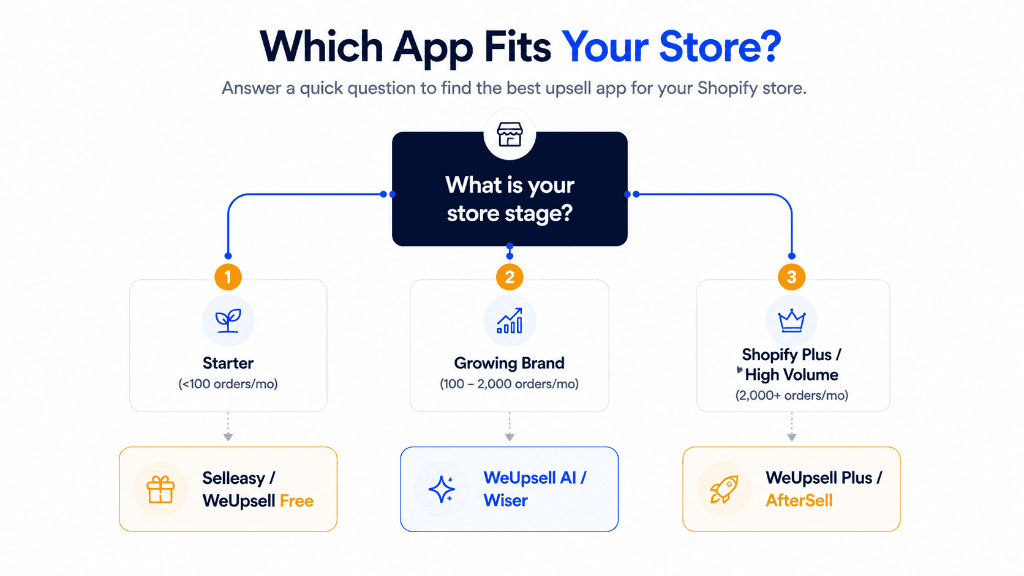
New or low-volume stores benefit most from apps with simple setup and a free tier — Selleasy, Bold Upsell, or WeUpsell's free plan — to confirm upselling actually converts on their catalog before investing further.
Growing stores generally need AI recommendation quality more than they need every placement covered, since manual curation stops scaling around the point order volume picks up. WeUpsell, Wiser AI, and Rebuy all fit this stage.
High-volume and Shopify Plus stores are the ones that benefit from true checkout-page placement, made possible by Checkout Extensibility. AfterSell, Zipify, and WeUpsell's checkout offer all target this tier specifically.
Frequently Asked Questions
What's the difference between an upsell and a cross-sell app?
An upsell offers a higher-value version of what's already in the cart — a bigger size, a premium tier. A cross-sell suggests something complementary instead — a case to go with a phone. Most apps in this comparison, WeUpsell included, handle both.
Do AI upsell apps slow down my store?
A well-built one shouldn't — post-purchase apps run after checkout and don't touch storefront speed at all, and product-page or cart apps that load asynchronously have minimal impact. If a store notices a slowdown after installing one, it's usually a configuration issue rather than something inherent to AI-driven offers.
How much can upselling actually increase AOV?
Commonly cited industry figures put the lift from well-placed upsells at 10–30%, with post-purchase offers specifically converting in the 15–25% range since the customer has already completed payment. Results depend heavily on how relevant the offers are — a simple app with well-matched offers will outperform a sophisticated AI platform with poorly matched ones.
Do I need Shopify Plus to use an AI upsell app?
No. Product page, cart, and post-purchase placements work on any Shopify plan. Only true in-checkout offers require Plus, because of Checkout Extensibility.
How many upsell apps should a store run at once?
Usually just one or two. Running multiple apps on the same placement — two cart-drawer apps, for example — tends to create conflicting offers rather than additional revenue.