
Getting more traffic is one way to grow a Shopify store. But there's another way that's often easier to overlook: getting more value from the customers who are already buying from you.
That's where Average Order Value (AOV) comes in. If one customer spends ₹1,500 and another spends ₹2,500, you're making more revenue from the second order without spending anything extra to acquire that customer. Even a small increase in what customers spend per order adds up fast once you're processing hundreds or thousands of orders a month.
The good news: increasing AOV doesn't mean pushing customers toward things they don't need. The strategies that actually work make the purchase more useful, more convenient, or more rewarding — not just bigger.
What Is Average Order Value (AOV)?
AOV = Total Revenue ÷ Number of Orders If your store generated ₹1,50,000 from 100 orders last month: ₹1,50,000 ÷ 100 = ₹1,500 AOV
Simple enough. But don't treat it as the only number that matters — an average can hide what's actually happening in your store. If a few customers place unusually large orders, they pull the average up even though most shoppers are spending far less. It's worth looking at what customers typically spend, not just the mathematical average, before you design any offer below.
Note: The exact AOV figure can vary slightly depending on the analytics platform you're using and whether discounts, taxes, shipping, or returns are included in the calculation. Check how your reporting tool defines it before comparing numbers across platforms.
Why Your Shopify AOV Might Be Low
Before jumping into tactics, it's worth diagnosing which problem you're actually solving. Low AOV usually comes from one of four places:
- 1. Customers don't know what else to buy. If your product and cart pages don't surface related items, most shoppers won't go looking for them — they'll just buy the one thing and leave.
- 2. There's no incentive to spend a little more. Without a free shipping threshold, a bundle discount, or a volume-pricing structure, there's simply no reason for a customer to add anything else.
- 3. The cart and checkout create friction instead of removing it. Hidden shipping costs, a cluttered cart, or no visible progress toward a reward all work against a bigger order.
- 4. Pricing isn't structured to reward a bigger basket. If every product is priced in isolation with no bundle, tier, or quantity break, customers have no financial reason to add a second or third item.
The 10 strategies below map directly onto these four problems.
1. Set a Free Shipping Threshold
Fixes: No incentive to spend more
One of the simplest ways to nudge a customer toward adding one more item: offer free shipping above a certain order value, instead of on every order.
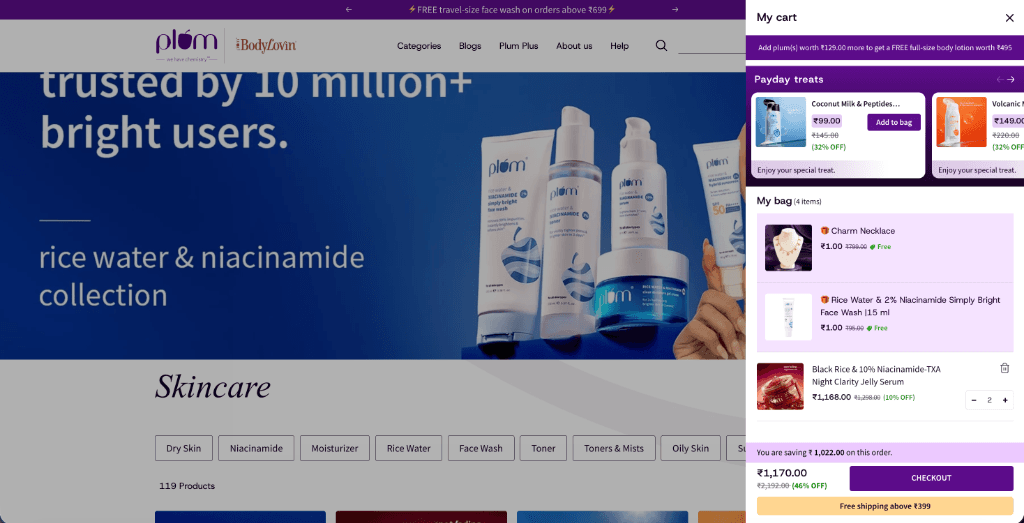
Real Store Example: Plum Goodness uses a free-shipping threshold of ₹399 and also promotes threshold-based gifts as part of its shopping experience.
Instead of free shipping on everything, try "Free shipping on orders over ₹1,999." Picture a customer with ₹1,750 already in their cart — they're only ₹249 away. Adding one more useful item often feels better than paying a separate shipping fee. Multiple industry surveys point in the same direction here: a notable share of shoppers say they've added items to a cart specifically to hit a free shipping threshold, though the exact figure varies by survey and shouldn't be treated as a fixed conversion guarantee for your store.
Tips for getting the threshold right:
- Don't pick a big round number because it sounds good — check what your typical order already is first.
- A common starting point is a threshold roughly 20–30% above your current AOV, but test it against your actual order distribution rather than treating that range as a rule.
- Use a visible cart progress bar ("You're ₹249 away from FREE SHIPPING 🎉") — the visibility does most of the persuading.
- Review the threshold periodically as your AOV, margins, shipping costs, and product mix change.
2. Create Product Bundles
Fixes: Customers don't know what else to buy
Customers don't always know which products go well together. A bundle solves that for them — a well-designed bundle can turn several related products into one larger purchase decision.
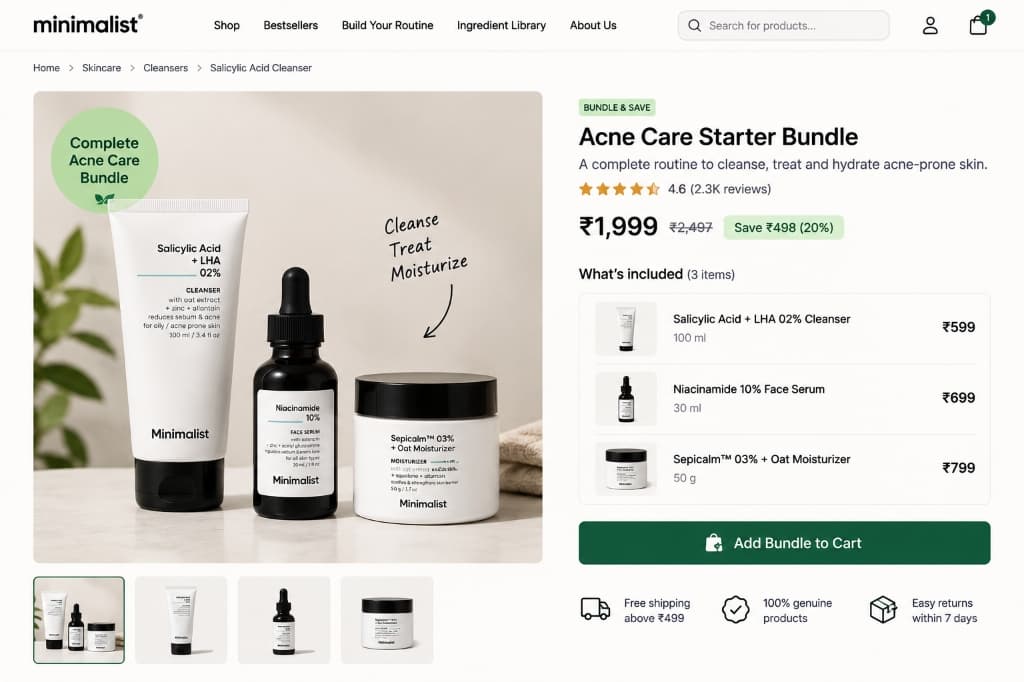
Example: Minimalist packages complementary skincare products into routine-focused bundles — like a cleanser, serum, and moisturizer sold together — giving shoppers a simpler way to buy a full routine in one order instead of hunting down each product separately.
Tips for building bundles that convert:
- Bundle products that are genuinely complementary — the pairing should be obvious, not something you have to explain.
- Show the savings clearly in rupees ("Save ₹XXX"), not just a percentage — a concrete amount tends to land better than an abstract percentage.
- Keep the discount in the 10–20% range to start; steeper discounts aren't always necessary to close the sale.
- A bundle should answer "what else would this customer actually need?" — if the answer isn't obvious, reconsider the pairing.
With WeUpsell, bundle offers like this can be built directly into product pages and cart drawer pages.
3. Add Relevant Upsells and Cross-Sells
Fixes: Customers don't know what else to buy
Upselling nudges someone toward a higher-value version of what they're already buying. Cross-selling suggests something that complements the purchase.
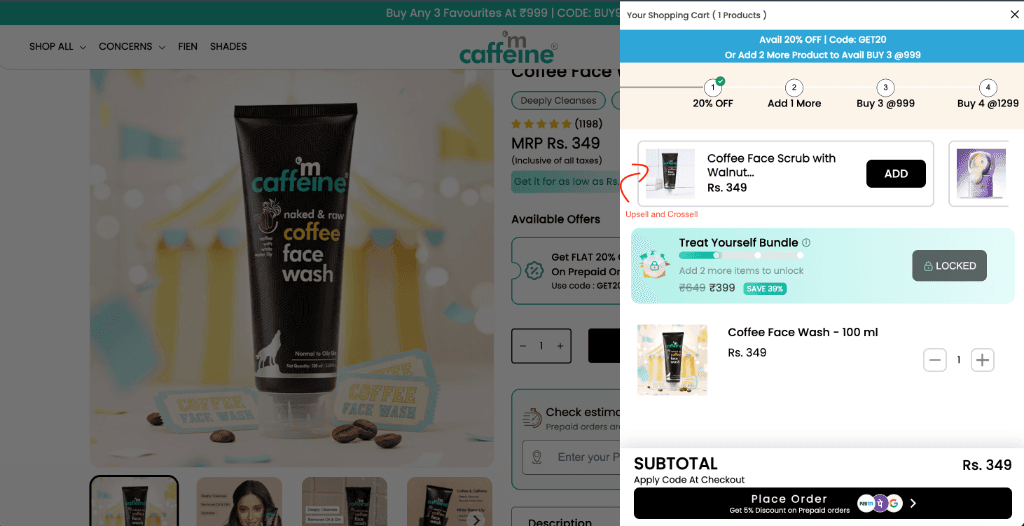
Real Store Example: mCaffeine pairs its Coffee Face Wash and Coffee Face Scrub as complementary products and also promotes quantity-based offers, such as buy any 3 for ₹999 or any 4 for ₹1,299.
The best cross-sells feel obvious in hindsight: running socks for someone buying running shoes, a phone case for someone buying a phone. That's far more useful than a random "bestsellers" list.
Tips for upsells that don't get ignored:
- Keep the price gap small — an add-on at 20–40% of the cart's value feels easy to say yes to; doubling the cart usually gets ignored.
- Show one strong, relevant offer rather than a wall of options — too many choices create decision fatigue.
- Cart-stage offers tend to outperform ones shown too early, before the customer has committed to buying anything.
WeUpsell's product-page and cart drawer upsell widgets are built around this — surfacing offers based on what's already in the customer's cart, not a generic catalog.
4. Offer Volume Discounts
Fixes: No incentive to spend more, pricing not structured for AOV
If customers regularly buy multiple units of the same product, give them a reason to increase quantity in a single order.
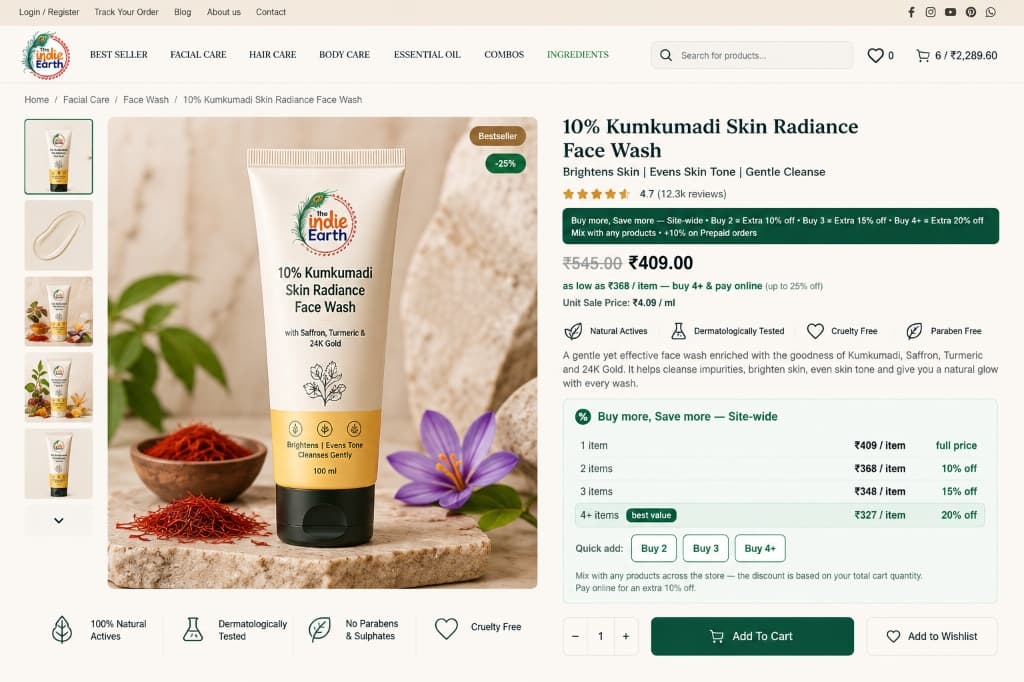
Real Store Example: The Indie Earth embeds a "Buy more, Save more" table directly on the product page — Buy 2 for 10% off, Buy 3 for 15% off, Buy 4+ for 20% off — with one-tap quick-add buttons so customers don't have to do the math themselves.
This works especially well for consumables — skincare, supplements, coffee, pet supplies — anything people are likely to repurchase anyway.
Tips for structuring volume discounts:
- Three tiers is usually the right number — more creates confusion, fewer removes the escalating incentive.
- Show the per-unit price at each tier, not just the percentage: "Each bottle drops to ₹599 at 3" is more persuasive than "15% off."
- Put the tiers directly on the product page, not buried in a cart popup, so the savings are obvious before the customer adds anything.
- The goal isn't convincing someone to buy five when they need one — it's making it easy for someone who was already going to buy three.
5. Create a Loyalty or VIP Program
Fixes: No incentive to spend more
Not every AOV strategy has to happen before checkout. A loyalty program gives customers a reason to spend more per visit because they're working toward something bigger than the current order.
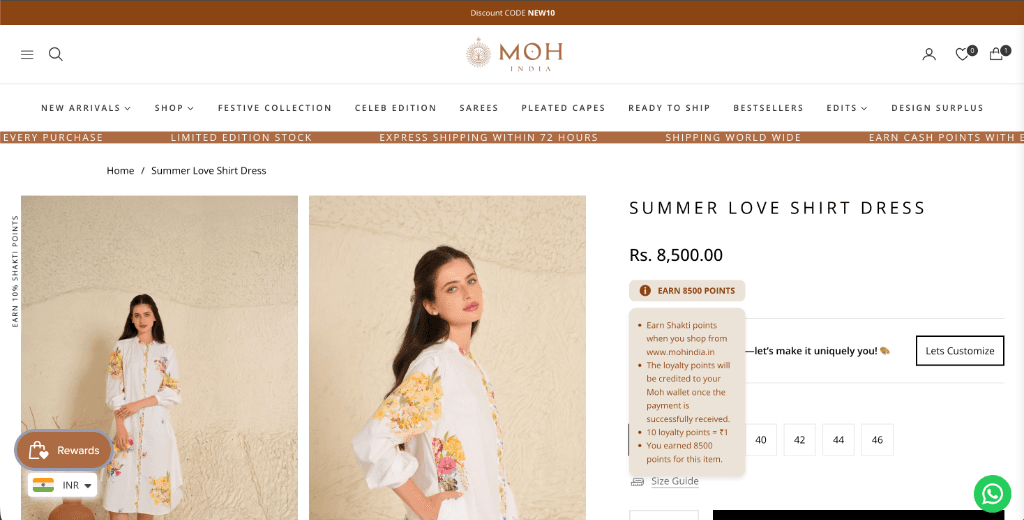
Example: MOH India displays the number of loyalty points a customer can earn directly on eligible product pages, making the reward visible before purchase rather than something discovered only after checkout.
This reframes "buy more" into something closer to "you're one step away from unlocking your next reward," which can feel more motivating than a plain discount for some shoppers.
Tips for a loyalty program that actually lifts AOV:
- Make the reward tiers visible on the product or cart page, not buried in an account dashboard.
- Give customers a clear next milestone ("₹300 more to reach Gold"), not just an abstract points balance.
- Pair tier perks (free shipping, early access) with something tangible, like a small gift, for the biggest pull.
- This works best for brands that already see repeat purchases — it compounds order value and retention together.
6. Recommend Products Based on What the Customer Is Buying
Fixes: Customers don't know what else to buy
Personalized recommendations work better when they're based on actual intent, not general popularity.
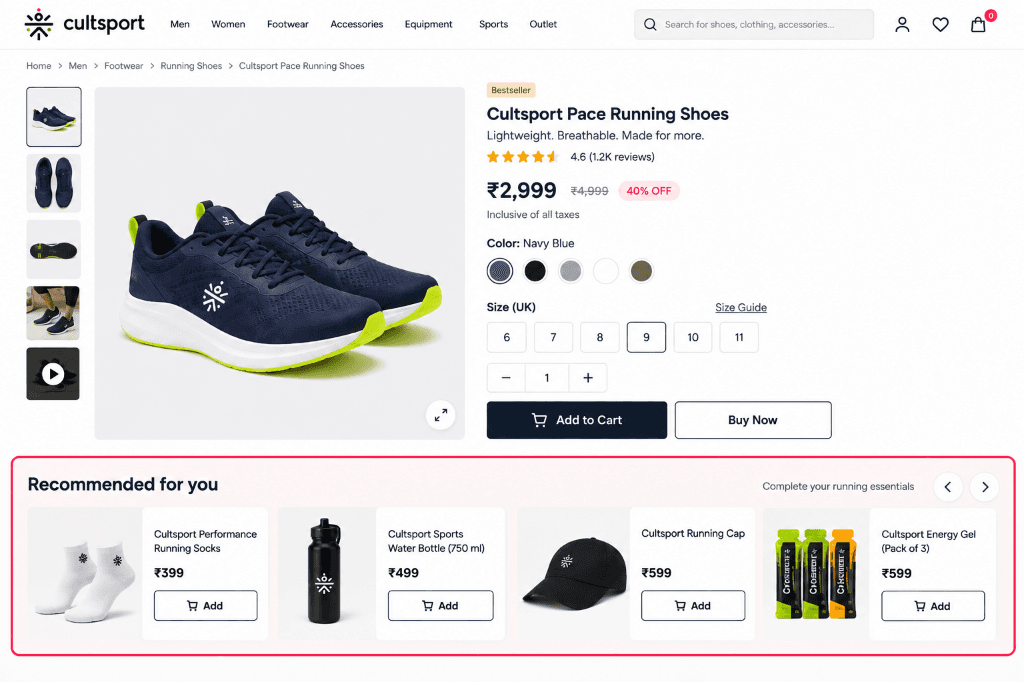
Illustrative Example: A running shoe product page could show complementary-product suggestions — running socks, a sports water bottle, a cap — based on what the shopper is currently viewing, rather than the site's general bestsellers.
The logic is simple: someone browsing running shoes is a far better candidate for running socks than for a generic bestseller list.
Tips for recommendations that convert:
- Start with the pages where intent is already strongest — the product page and cart drawer — rather than covering the whole site at once.
- Match the recommendation to the specific product being viewed, not the store's general catalog.
- Keep the add-to-cart action one click away; extra steps kill impulse adds.
- A targeted recommendation tends to feel more relevant than a generic offer because it's connected to what the shopper is already viewing or has in their cart — worth testing against a blanket "bestsellers" widget to see the difference for your own store.
WeUpsell's recommendation widgets can sit across the product page, cart drawer, and checkout — tailored to what's already in view.
7. Use a "Complete the Set" Offer
Fixes: Customers don't know what else to buy
This goes a step beyond a normal recommendation — instead of asking "want anything else?", it shows customers how the products work together as a finished look.
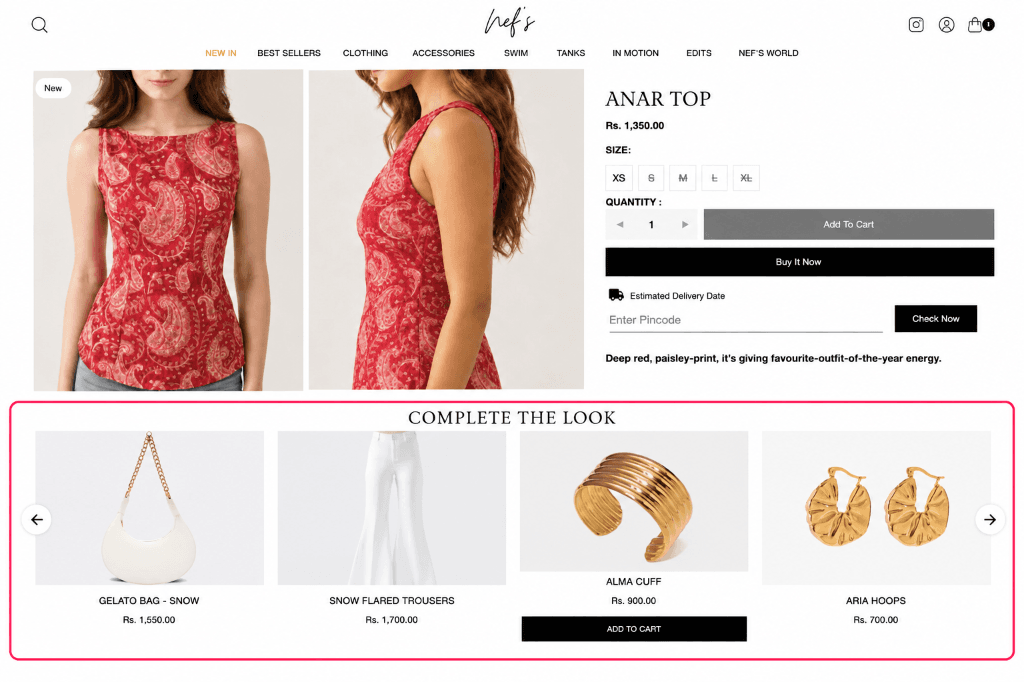
Real Store Example: Nef's uses a "Complete The Look" section below selected fashion products, pairing the main item with complementary bags, trousers, and jewelry — turning a single top into a full outfit order.
Tips for this to land well:
- It's especially effective for fashion, beauty, home decor, and lifestyle — categories where the appeal is the whole look or routine, not one item.
- Frame it around the finished result ("Complete the look," "Complete your routine") rather than as more product suggestions.
- Keep the set to 2–4 items — enough to build a picture, not so many it feels like a catalog dump.
8. Add a Post-Purchase Upsell
Fixes: Cart and checkout friction
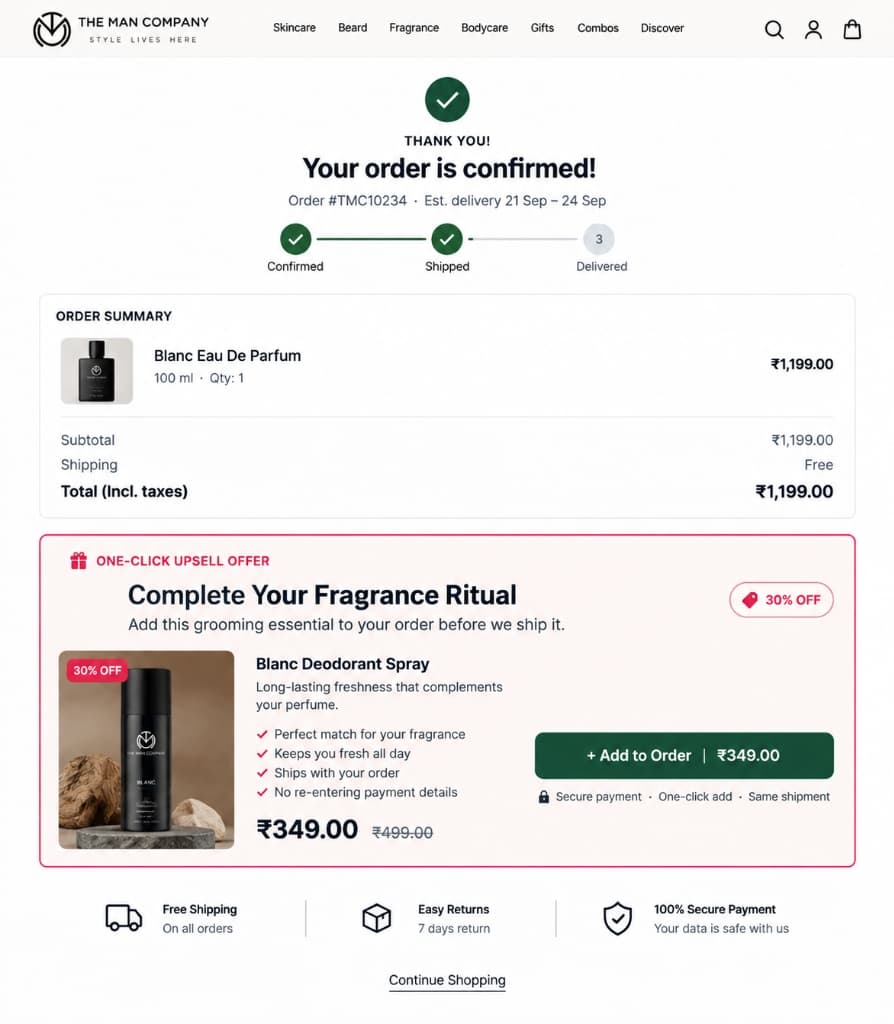
The customer has already completed the purchase. Instead of ending the journey there, offer one relevant product they can add after checkout — with a one-click add-to-order experience where supported.
Illustrative Example: After purchasing a fragrance, a shopper could be shown a matching deodorant spray at a discounted price directly after checkout — a "Complete Your Fragrance Ritual" style offer, with a one-click add-to-order experience where supported.
Because the original purchase is already complete, a relevant post-purchase offer can increase order value without adding another decision point to the initial checkout — though it's still worth keeping the offer simple so it doesn't feel like friction right after a customer has paid.
Tips for post-purchase upsells:
- Show one strong recommendation, not five — "You bought the coffee machine, add your favorite beans" beats a crowded list.
- Keep the connection to the original purchase obvious; the more relevant it is, the more it feels like a natural next step rather than a sales pitch.
- Run this as a fully separate offer from your checkout-stage upsell and test each independently — they convert differently.
WeUpsell can run this as a dedicated post-purchase offer, separate from anything else in your checkout flow.
9. Offer a Free Gift at a Spending Threshold
Fixes: No incentive to spend more
A discount reduces what the customer pays. A free gift increases the perceived value of the purchase — often feeling more exciting even at a similar rupee value.
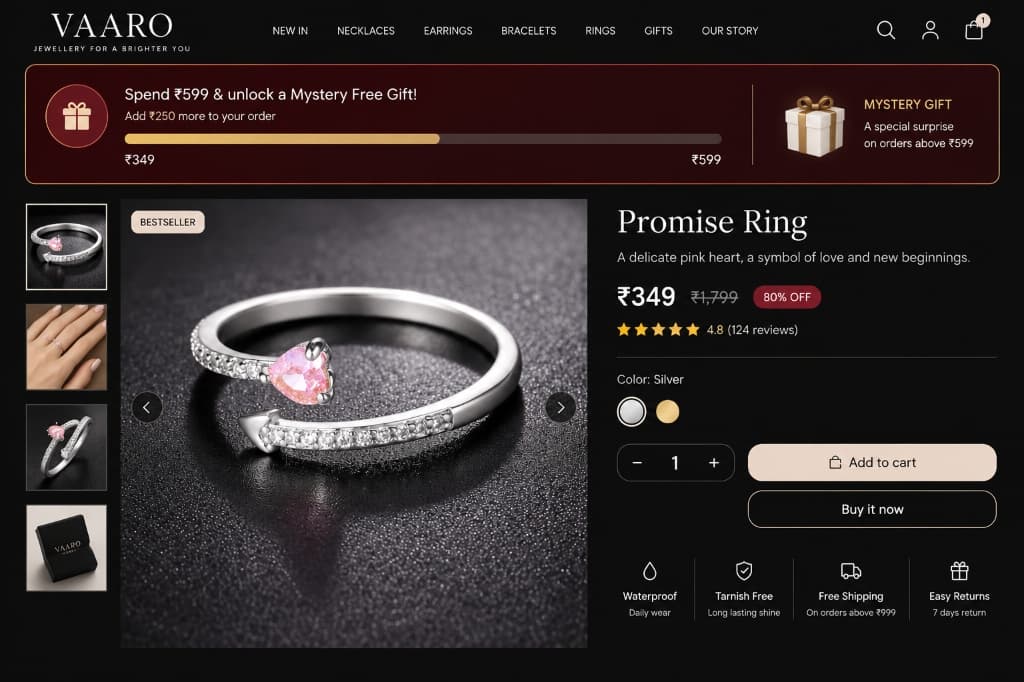
Real Store Example: Vaaro Jewellery motivates shoppers viewing a ₹349 Promise Ring with an interactive threshold bar: "Spend ₹599 & unlock a Mystery Free Gift! Add ₹250 more to your order."
A customer sitting at ₹2,250 against a ₹2,500 gift threshold suddenly finds a ₹300 add-on much more appealing than they otherwise would.
Tips for free-gift campaigns:
- Start with a threshold slightly above your typical order value, then test whether customers actually stretch their baskets to reach it — treat the exact percentage as something to test, not a fixed rule.
- Choose a gift that's genuinely desirable (a full-size sample, a popular mini product) — generic filler items undercut the whole offer.
- Pair it with the same kind of cart progress messaging as your free-shipping bar: "₹250 more to unlock your FREE gift 🎁."
- This works particularly well for beauty, wellness, food, and lifestyle brands that already have smaller, lower-cost products to use as the gift.
10. Test Different Offers Instead of Guessing
Fixes: All of the above
No single AOV strategy works identically for every store. A free-shipping threshold might do wonders for one brand and almost nothing for another.
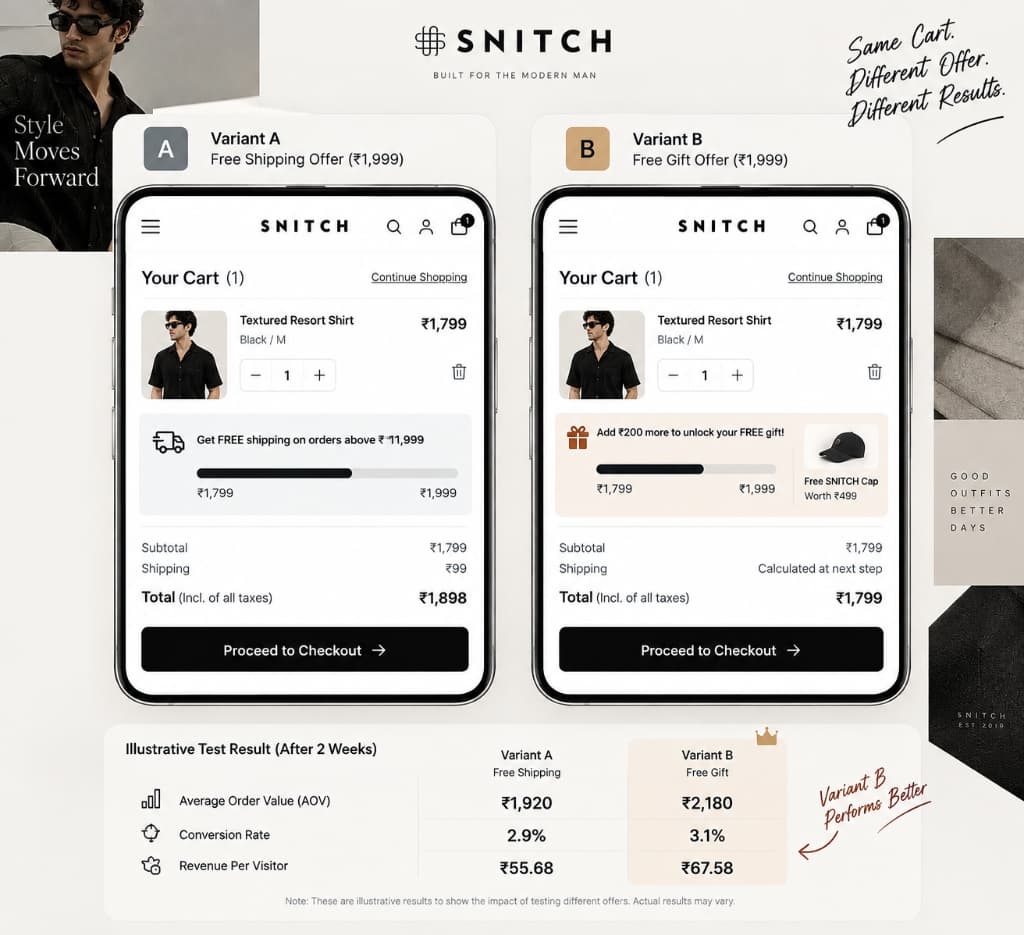
Illustrative A/B Test: Imagine testing two offer mechanics on the same cart drawer at the same ₹1,999 threshold — Free Shipping vs. Free Gift. Say Variant A (free shipping) lands at ₹1,920 AOV, and Variant B (free gift) lands at ₹2,180 AOV — a result you'd only know by actually running the test, not by assuming one option is better. These figures are illustrative, not a published result from any specific store; your own test is the only way to know which works for your store.
That's the kind of result you only find by testing — not by assuming.
Tips for testing properly:
- Change one variable at a time: free shipping over ₹1,999 vs. ₹2,499, a discount vs. a free gift at the same threshold, a product-page upsell vs. a cart-page upsell.
- Give each version enough time to collect real data before deciding which variation performed better.
- Don't judge success by AOV alone — check whether conversion rate held up and whether revenue per visitor actually improved. A higher AOV isn't a win if it came at the cost of a much lower conversion rate.
Which Strategy Should You Try First — and Where
| If your store has... | Try... | Best place to test it |
|---|---|---|
| Many carts just below a round number | Free shipping threshold | Cart drawer |
| Products commonly bought together | Bundles or "complete the set" | Product page + cart drawer |
| Customers buying only one unit | Volume discounts | Product page |
| Strong repeat purchases | Loyalty program | Site-wide + account area |
| Lots of complementary products | Cross-sells / upsells | Product page + cart drawer |
| Low-cost, relevant accessories | Post-purchase upsells | Post-purchase page |
| Good-margin products for gifting | Free gift threshold | Cart drawer |
| Varied customer preferences | Personalized recommendations | Product + cart + checkout |
| Uncertainty about which offer will work best | A/B testing | Across key placements |
Don't try to run all ten at once. Pick the row that matches your store today, solve that problem, then move to the next.
Why Increasing AOV Actually Matters
- More revenue per order. Higher revenue per transaction means you're covering costs and earning margin faster on every sale, without touching your acquisition budget.
- Better economics on the traffic you already have. Customer acquisition cost stays roughly the same regardless of order size — so a higher AOV directly improves the return on every rupee spent acquiring that customer.
- Potentially higher customer lifetime value. A customer who's comfortable adding to their cart tends to keep coming back, which compounds over time — though this depends on the overall experience, not AOV alone.
How to Measure Whether It's Actually Working
Track these metrics together, not AOV in isolation:
- Average Order Value — has the number itself moved?
- Conversion rate — are your offers creating friction anywhere?
- Revenue per visitor — are you generating more from the same traffic?
- Offer acceptance rate — how many customers actually take the upsell or cross-sell?
- Average items per order — the clearest signal for bundles and volume discounts specifically
If AOV moves from ₹1,500 to ₹1,650 and average items per order moves from 1.4 to 1.8 at the same time, you have a much clearer picture of what actually changed than looking at AOV alone.
What a 10% Lift Actually Looks Like
Say your store gets 1,000 orders a month at a ₹1,500 AOV — that's ₹15,00,000 in monthly revenue.
Increase AOV by just 10%, to ₹1,650, at the same 1,000 orders, and you're at ₹16,50,000 — an extra ₹1,50,000 a month, without acquiring a single new customer.
That's not guaranteed, and margins and conversion rate still matter. But it's a useful reminder of why a relatively small AOV improvement is worth testing seriously.
Where WeUpsell Fits Into This
The strategy comes first, the tool second. Installing an upsell app and then hunting for somewhere to put an offer tends to produce weak, generic campaigns.
Better to start with: what do I actually want the customer to do next? Add a complementary product, buy a bundle, bump up quantity, cross a free-shipping line, add something after checkout, unlock a free gift. Once that's clear, WeUpsell can be used to build the specific offer — across product pages, cart drawer, and post-purchase — and to test different products, messages, and placements against each other rather than running one static offer for every customer.
FAQs on Increasing AOV on Shopify
What's a good average order value for a Shopify store?
There's no single number — it varies a lot by category (beauty and food tend to run lower, jewelry and electronics higher). What matters more is your own trend over time: is AOV moving up or down compared to last quarter?
What's a good first AOV strategy to test?
A free shipping threshold is a practical first test because it's relatively simple to set up in Shopify and can encourage shoppers who are already close to the threshold to add another item. A cart cross-sell or post-purchase upsell are good next steps.
Do free gifts work better than discounts?
Not always. A free gift can make an offer feel more valuable than an equivalent discount, but the result depends on the product, the gift itself, the threshold, and your margins. Test the two against each other rather than assuming one will win.
How long should I run a test before deciding if an offer works?
Long enough to collect a meaningful sample of orders — a few weeks is a reasonable starting point for most stores, longer for lower-traffic ones.
Can I run more than one of these strategies at once?
Yes, but stagger them. Running everything at once makes it hard to tell which change actually moved the number. Start with one or two, measure, then layer in more.
Does a higher AOV always mean more profit?
Not automatically — check conversion rate and margin alongside it. An offer that raises AOV but tanks conversion, or relies on a steep discount, can still hurt overall revenue.
Final Thoughts
Increasing AOV isn't about convincing customers to spend as much as possible. It's about making it easier for them to discover products that genuinely add value to what they're already buying.
- Set a realistic free-shipping threshold.
- Bundle products that naturally belong together.
- Add relevant cart cross-sells.
- Offer quantity discounts where customers are likely to buy multiples.
- Give repeat customers a reason to spend more.
- Recommend products based on actual intent, not general popularity.
- Try a "complete the set" offer.
- Add a post-purchase upsell.
- Use a free gift to pull customers toward a spending threshold.
- Test your offers instead of assuming you already know what will win.
If you're just starting out, pick one or two of these rather than changing everything at once — a cart cross-sell, a free-shipping threshold, or a post-purchase offer are all good places to begin. Measure what happens, learn what your customers respond to, and build from there.
The goal isn't simply a bigger cart. It's a better shopping experience that naturally leads to a more valuable order.